Dealing with an online purchase dispute can be frustrating and time-consuming. Whether it’s a non-delivery, damaged product, wrong item, billing error, or refund problem, the outcome usually depends on the quality of your evidence. Many consumers lose legitimate claims simply because they didn’t keep proper records.
Why Evidence Matters in an Online Purchase Dispute
Merchants investigate complaints using your records. Banks and credit card issuers require solid proof for chargeback evidence during payment disputes. Dispute resolution platforms and government agencies also need clear documentation.
Good evidence shifts the burden and shows you acted responsibly. It helps prove your case in refund disputes, merchant disputes, and billing disputes. Without it, sellers can deny responsibility, and banks may side with the merchant.
What Evidence Should You Save?
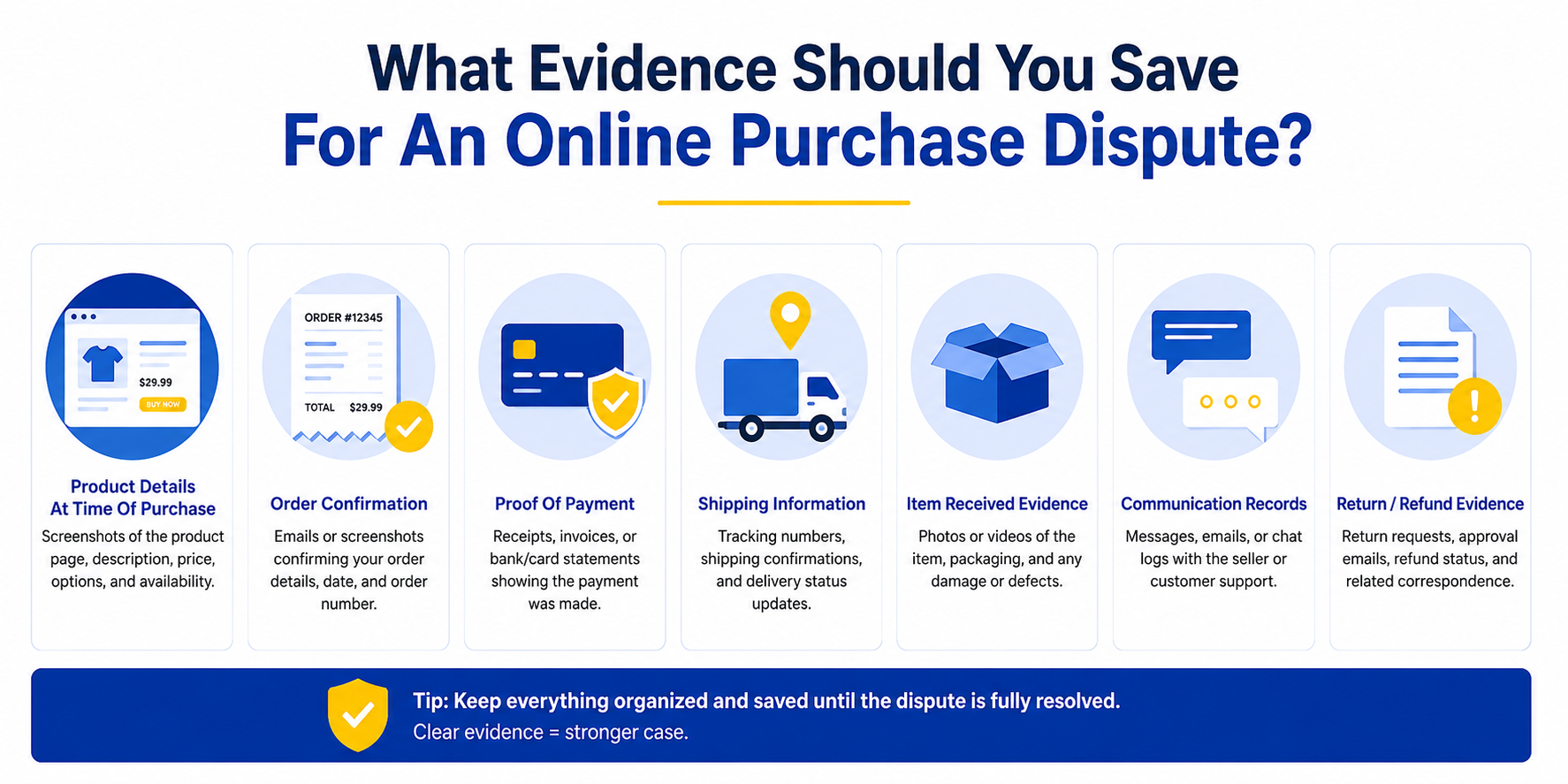
1. Order Confirmation Emails
Always keep the confirmation email. It contains:
- Order number
- Purchase date and time
- Exact product details and price
- Seller contact information
This serves as primary proof of purchase and establishes the timeline for any online order problem.
2. Payment Receipts and Transaction Records
Download or screenshot:
- Credit card or bank statements showing the charge
- Digital wallet receipts (PayPal, Apple Pay, etc.)
- Any authorization or pending transaction details
These records are essential for disputed transactions and duplicate charge claims.
3. Product Listings and Descriptions
Save the original product page (or screenshot it) including:
- Title and description
- Price and any promotional claims
- Size, color, specifications, and photos
This helps prove misrepresentation in refund disputes or when the delivered item doesn’t match the listing.
4. Screenshots of the Order Process
Capture:
- Shopping cart summary
- Checkout page with shipping and payment details
- Final confirmation screen
Screenshots preserve visual proof that can’t be altered later.
5. Delivery and Tracking Information
For any delivery issue:
- Tracking number and carrier updates
- Delivery confirmation or “signed for” records
- Photos of the package upon arrival (even if unopened)
These are crucial for item not received claims.
6. Photos and Videos
Take clear, well-lit photos and videos of:
- The package and shipping label
- Damaged or defective items
- Wrong or missing contents
- Comparison with the original product listing
Visual evidence is extremely powerful in online shopping disputes.
7. Communication With the Seller
Document every interaction:
- Emails and responses
- Live chat transcripts (screenshot or export)
- Support ticket numbers and updates
- Social media direct messages
Keep dates and times. This creates a paper trail for consumer complaints.
8. Refund and Return Documentation
Save:
- Return authorization numbers
- Shipping labels and tracking for returns
- Proof of return delivery
- Any refund confirmation emails
Evidence Checklist for Common Online Purchase Disputes
|
Dispute Type |
Most Important Evidence |
|
Item Not Received |
Tracking records, order confirmation, delivery attempts |
|
Damaged Product |
Photos, videos, packaging condition, receipts |
|
Wrong Item Received |
Product listing screenshots, photos of received item |
|
Refund Refusal |
Communication records, return tracking |
|
Duplicate/Billing Error |
Bank statements, transaction records, order confirmation |
|
Fraudulent Seller |
All of the above plus payment method details |
How Long Should You Keep Purchase Records?
Keep records for at least 60–120 days for most refund and chargeback windows. For warranties or extended disputes, retain them for 1–2 years. Credit card chargeback deadlines are often 60–120 days from the transaction or statement date. Check your card issuer’s policy. Digital storage (cloud folders or email archives) makes long-term keeping easy.
Common Evidence Mistakes Consumers Make
- Deleting order confirmation emails too soon
- Failing to photograph damaged items before returning
- Not documenting conversations with customer service
- Waiting too long to gather records
- Relying only on memory instead of screenshots
Avoid these pitfalls to strengthen your consumer complaint.
How Evidence Helps with Chargebacks and Refunds
Strong chargeback evidence helps banks reverse disputed transactions quickly. For payment disputes, issuers often side with customers who provide clear documentation. Merchants are more likely to approve refunds when faced with organized proof. In severe cases, evidence supports complaints to the Better Business Bureau, state consumer protection offices, or the FTC.
Understanding Your Consumer Rights
Under the Fair Credit Billing Act (FCBA), you have rights regarding billing errors and disputed transactions on credit cards. Many debit cards and payment platforms offer similar protections. You generally have the right to dispute charges for goods not received or not as described. Keeping records demonstrates you followed proper procedures, which strengthens your position.
How RaiseAComplaint.com Can Help
When a dispute remains unresolved despite your best efforts, RaiseAComplaint.com offers a practical solution. This free public platform lets consumers document their online purchase dispute in detail so others can learn from real experiences.
Here is how it supports you:
- Share a complete account of your situation including what happened with the order, delivery issue, or merchant dispute.
- Upload supporting evidence such as order confirmations, photos, tracking records, and communication screenshots to strengthen your case.
- Create a public consumer complaint that increases visibility and puts pressure on the business to respond.
- Benefit from many companies actively monitoring the site to protect their reputation and resolve issues quickly.
- Read honest consumer reviews and ratings from others facing similar online shopping disputes or refund problems.
- Contribute to a community resource that helps future buyers avoid the same problems through transparent feedback.
RaiseAComplaint.com serves as a helpful bridge between frustrated consumers and businesses. By posting your story on this dedicated platform for consumer complaints, reviews, and ratings, you not only seek resolution for your own case but also empower the wider community. Many users report faster responses after going public with well-documented evidence. How Long Do Credit Card Disputes Take
The Bottom Line
Keeping organized documentation is the single best way to protect yourself during an online purchase dispute. By saving order confirmations, transaction records, photos, tracking information, and communication logs, you put yourself in the strongest position possible for refunds, chargebacks, and resolutions.
Create a dedicated folder on your phone or computer right after every online purchase. Save confirmations immediately and take photos upon delivery. When an online order problem arises, gather your evidence before contacting the seller. This simple habit can save you time, money, and stress.
Visit RaiseAComplaint.com to document unresolved issues and help build pressure for fair resolutions. Protecting your consumer rights starts with good record-keeping. How to Dispute Unauthorized Charges on Your Credit Card
Frequently Asked Questions
What evidence do I need for a chargeback?
For a successful chargeback, gather strong chargeback evidence including your proof of purchase (order confirmation), detailed transaction records from your bank or credit card statement, all communication with the seller, and clear proof of the problem such as photos, videos, or tracking information. Submit the complete package to your card issuer as soon as possible. Well-organized documentation significantly improves your chances of winning payment disputes and disputed transactions.
Should I keep screenshots of online purchases?
Yes, you should always keep screenshots of online purchases. Capture product pages, pricing, promotional claims, shopping cart summaries, checkout screens, and order confirmations. Websites can change or remove listings, so screenshots serve as reliable purchase dispute evidence that preserves exact details. They are quick to take, easy to store in a dedicated folder, and highly effective during online shopping disputes.
How long should I keep receipts for online shopping?
Keep digital and paper receipts for at least 60–120 days to cover most refund windows and chargeback deadlines. For big-ticket items, warranties, or extended refund disputes, retain records for one to two years. Use organized digital folders or cloud storage so everything stays accessible. Proper record-keeping protects you in any online order problem or billing dispute.
Can photos help with a dispute?
Absolutely. Photos and videos are often the most convincing evidence in online shopping disputes. Take clear, well-lit images from multiple angles showing damaged products, wrong items, missing parts, packaging condition, and shipping labels. Compare them with the original product listing. Visual proof strengthens your case with merchants, banks, and during consumer complaints. Always document before returning anything.
What if the seller stops responding?
If the seller stops responding, escalate the matter by filing a chargeback with your bank or payment provider using all your saved records. Simultaneously, post a detailed consumer complaint on RaiseAComplaint.com to create public visibility. You can also contact your state consumer protection agency or the FTC. Thorough documentation becomes even more critical when direct communication fails.
What records should I save for refund requests?
For any refund dispute, save your order confirmation, payment receipts, return authorization, shipping labels, return tracking numbers, communication history, and clear photos of the item received. This complete set of records demonstrates your good-faith effort and gives merchants little room to deny a legitimate refund request. Keep everything organized from the moment an online purchase dispute arises.