Fake customer support numbers appear in search results, sponsored ads, or fake websites mimicking legitimate companies. Key warning signs include numbers not listed on the official company site, representatives asking for remote access, passwords, OTPs, or immediate payments via gift cards or wire transfers, high-pressure tactics, and generic greetings. Always verify by going directly to the company's official website or app—never trust search results alone. Legitimate support won't demand sensitive info or urgent unusual payments. If in doubt, hang up and check your account statements or official emails for verified contacts. How can you spot fake customer support numbers?
What Are Fake Customer Support Numbers?
Fake customer support numbers are phone numbers set up by scammers to impersonate legitimate businesses. They pose as customer service, tech support, or helplines for banks, retailers, software companies, and more. These are central to customer support scams, tech support scams, and customer service fraud.
Scammers create fake customer service numbers that appear trustworthy. They use them in phishing scams, spoofed calls, or listings on fake support websites. Victims call thinking they're reaching official help for online shopping issues, account access problems, subscription glitches, or banking concerns, only to face fraudulent customer support.
These scams often involve scam phone numbers that lead to representatives who extract personal or financial data, install malware, or demand payment for nonexistent problems.
Why Fake Customer Support Scams Are So Effective
Scammers succeed because they exploit urgency. When your bank account looks off, a subscription fails, or your computer acts up, you need quick help. Searching online for a fake helpline number feels natural.
People trust recognizable brands. Scammers abuse search engines with optimized fake sites and ads. Social media and forums spread misinformation. Many consumers overlook subtle clues during stress, making online scam tactics highly effective.
Common Places Consumers Find Fake Customer Support Numbers
Scammers target where people look:
- Search engine results and sponsored ads: Fake listings often appear first.
- Fake support websites: Near-identical designs with stolen logos and suspicious URLs.
- Social media posts and ads: Promoted "support" links.
- Online forums and directories: Unsolicited recommendations.
- Pop-ups, emails, or texts: Directing you to call a scam customer care number.
Warning Signs of Fake Customer Support Numbers
Watch for these scam warning signs of support phone scams and fraudulent customer support.
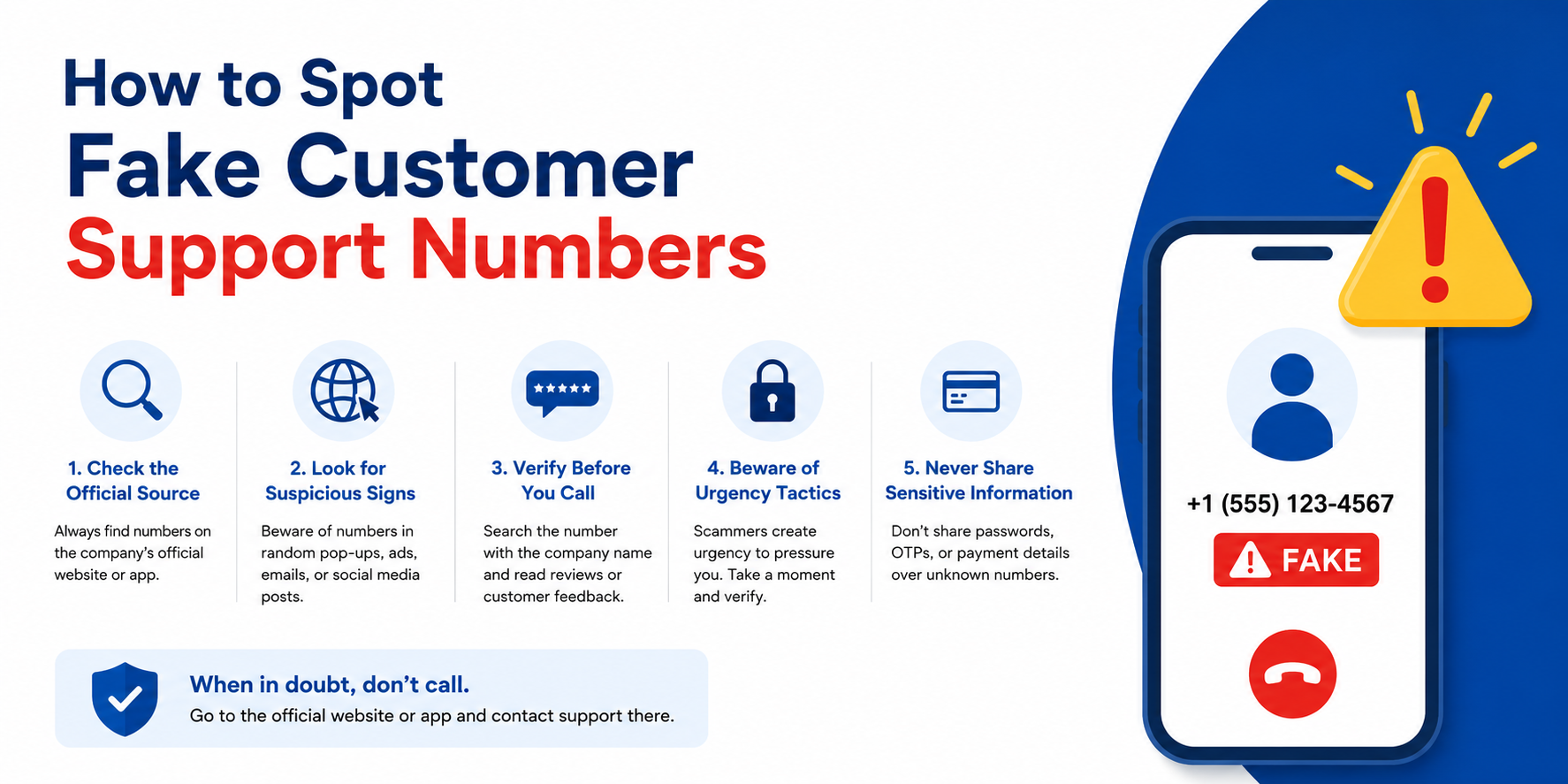
1. The Number Does Not Appear on the Official Website Legitimate numbers are listed clearly on the company's site. If it's missing or only in search results, it's likely fake.
2. The Representative Requests Remote Access They ask to "fix" your computer or device. Real support rarely does this unsolicited. Granting access risks malware.
3. They Ask for Passwords or Verification Codes Never share logins, OTPs, or full account details. Legitimate reps verify via account info you already provide.
4. They Demand Immediate Payment Pressure for quick payment signals a customer support scam. Real companies use official billing.
5. They Request Gift Cards, Cryptocurrency, or Wire Transfers These untraceable methods are huge red flags for scam phone number schemes.
6. High-Pressure Tactics and Threats Threats to close accounts, freeze funds, or involve "authorities" create panic. Legitimate support gives you time.
7. Poor Website Quality or Suspicious URLs Typos, odd domains (e.g., company-support-help.net instead of company.com), or missing security indicators.
8. Generic Greetings Instead of Company Identification Vague "Hello, how can I help?" without naming the company or using your details properly.
How to Verify a Customer Support Number Safely
Follow this step-by-step process to avoid fake support website traps:
1. Visit the company's official website directly — Type the URL manually or use a bookmark. Avoid search links.
2. Use the official contact page — Look for phone numbers there.
3. Verify the domain name — Ensure it's exact (e.g., amazon.com, not amaz0n-support.com).
4. Check official mobile apps — Many provide verified support options.
5. Review account statements and official emails — Use numbers listed there.
6. Use verified social media accounts — When appropriate, but prefer the main website.
For tech issues, check the software's built-in help first.
What Information Should You Never Share?
Protect these details:
- Passwords and login credentials
- One-time passcodes (OTPs)
- Social Security numbers or full ID info
- Banking credentials or credit card security codes
- Authentication app codes
Legitimate companies don't request these over unsolicited calls or chats. They use secure in-account verification. Sharing enables identity theft and phishing scam damage.
What to Do If You Called a Fake Customer Support Number
Act quickly:
1. End the call immediately — Don't engage further.
2. Change passwords — For affected accounts and enable two-factor authentication.
3. Contact your bank or card issuer — Report potential fraud and request new cards if needed.
4. Monitor financial accounts — Watch for unauthorized activity.
5. Scan devices for malware — If remote access was granted, use reputable security software.
6. Report the scam — Details below.
How to Report Customer Support Scams
Reporting helps stop consumer protection issues:
- Federal Trade Commission (FTC): ReportFraud.ftc.gov
- FBI Internet Crime Complaint Center (IC3): ic3.gov
- Consumer Financial Protection Bureau (CFPB): consumerfinance.gov
- State consumer protection agencies and local authorities
Include phone numbers, websites, and details shared.
Common Industries Targeted by Customer Support Scams
- Banks and financial services — Account "issues"
- Airlines and travel — Booking problems
- E-commerce companies — Order or refund scams
- Streaming services — Subscription glitches
- Software and tech companies — Virus alerts (classic tech support scam)
- Telecommunications providers — Service disruptions
- Delivery services — Package issues
How RaiseAComplaint.com Can Help
At RaiseAComplaint.com, we empower consumers facing unresolved issues. Share your experience with fake customer support numbers or customer service fraud to warn others, document problems, and push companies for accountability. Your reports build public awareness, support online safety, and encourage better practices across industries. Join our community to turn frustration into action.
Wrapping Up
Spotting fake customer support numbers comes down to caution and verification. Ignore unverified numbers, never share sensitive info or grant remote access, and always go directly to official sources. Stay vigilant with urgent account issues, and use resources like RaiseAComplaint.com to share experiences and strengthen consumer protection. By following these steps, you protect yourself and help others avoid online scam pitfalls. Your awareness makes a difference in the fight against customer support scam tactics. How to Dispute Unauthorized Charges on Your Credit Card
Frequently Asked Questions
How do I know if a customer support number is fake?
Check whether the number appears on the company’s official website under the contact page. Warning signs of a fake customer support number include requests for remote device access, passwords, one-time codes, or immediate payments. Genuine representatives rarely ask for these over the phone. Always verify by typing the official company URL directly into your browser instead of clicking search results. If the number only shows up in ads or suspicious directories, treat it as a potential customer support scam and hang up.
What should I do if I gave information to a scammer?
End the call immediately. Change all affected passwords and enable two-factor authentication. Contact your bank or credit card issuer right away to report fraud and request a new card if needed. Monitor your accounts closely for unauthorized activity. Run a full malware scan on your devices if you granted remote access. Report the incident to the FTC and IC3. Acting quickly can limit damage from customer service fraud and help with potential recovery.
Can scammers spoof legitimate phone numbers?
Yes. Scammers use caller ID spoofing technology to make scam phone numbers appear as if they’re coming from a trusted company. This is common in tech support scams and support phone scams. Never trust the name or number displayed on your phone. Always verify the contact independently by visiting the official website or using a number from your account statements or verified app. Spoofing makes fake customer service numbers look real, so independent verification is essential.
How do I verify a customer service number?
Go directly to the company’s official website by typing the correct URL (e.g., amazon.com). Navigate to the official “Contact Us” or support page. Cross-check with numbers listed in your account statements, order confirmations, or official emails. Use the company’s mobile app when available. Ignore numbers from search engines, sponsored ads, or third-party sites. This process helps you avoid fake helpline numbers and fraudulent customer support.
What information should I never share with customer support?
Never share passwords, one-time passcodes (OTPs), full Social Security numbers, bank login credentials, credit card security codes, or authentication app tokens during unsolicited calls or chats. Legitimate companies do not request these details over the phone because they already have secure ways to verify your identity. Sharing this information can lead to identity theft and serious financial loss in phishing scams and online scam schemes.
Are sponsored search results always trustworthy?
No. Scammers frequently pay for sponsored ad placements to promote fake customer service numbers and fake support websites that appear at the top of search results. These listings often mimic real companies but lead to customer support scams. Always scroll past ads and go directly to the official website. Sponsored results are not verified for accuracy, making them a common entry point for scam customer care numbers.
How do I report a fake customer support scam?
Report the fake customer support number and related details to the Federal Trade Commission at ReportFraud.ftc.gov. File a complaint with the FBI’s Internet Crime Complaint Center (IC3.gov). You can also contact the Consumer Financial Protection Bureau (CFPB) or your state’s consumer protection agency. Provide the phone number, website, any names used by the scammers, and details of the interaction. Reporting helps build awareness and supports consumer protection efforts.