There is nothing more frustrating than submitting a complaint to a business and getting nothing back — no acknowledgment, no apology, no resolution. If a company ignores your complaint, you’re not alone. Millions of American consumers find themselves stuck in this same situation every year, unsure of what to do next.
Silence from a business doesn’t mean you are out of options. There are clear, practical steps you can take to escalate your complaint, protect your rights, and improve your chances of getting the outcome you deserve.
Why Companies Sometimes Ignore Customer Complaints
Before you escalate, it helps to understand why your complaint may have gone unanswered in the first place. Businesses don’t always ignore consumers out of bad faith — though sometimes they do. Common reasons include:
- High complaint volumes: A business with thousands of daily inquiries may let some fall through the cracks.
- Poor customer service systems: Disorganized support departments often lose track of incoming complaints.
- Staff shortages: Understaffed support teams simply can’t respond to everyone in a timely way.
- Incomplete submissions: If your original complaint was missing key information (like an order number or account ID), it may have been deprioritized or ignored.
- Lack of escalation procedures: Some smaller businesses don’t have any formal process for handling complaints.
- Intentional delay tactics: Some companies hope that if they wait long enough, the consumer will give up and move on.
- Communication breakdowns: Emails end up in spam folders, support tickets get misrouted, or phone calls go unlogged.
Understanding the root cause can help you choose the right escalation strategy.
How Long Should You Wait Before Following Up?
Response timelines vary depending on the type of business. Here are reasonable windows for most industries:
|
Business Type |
Reasonable Response Window |
|
Retail Businesses |
3–5 business days for email; immediate for in-store or live chat |
|
Subscription Services |
2–3 business days; many offer live chat for faster resolution |
|
Banks and Financial Institutions |
5–10 business days; legally required in certain dispute scenarios |
|
Airlines and Travel Providers |
7–14 days; some have regulatory requirements for response timelines |
|
Telecom and Internet Providers |
3–5 business days; escalation to the FCC is available if unresolved |
If your complaint falls outside these windows, it’s time to take action.
Step-by-Step Actions to Take When a Company Ignores Your Complaint
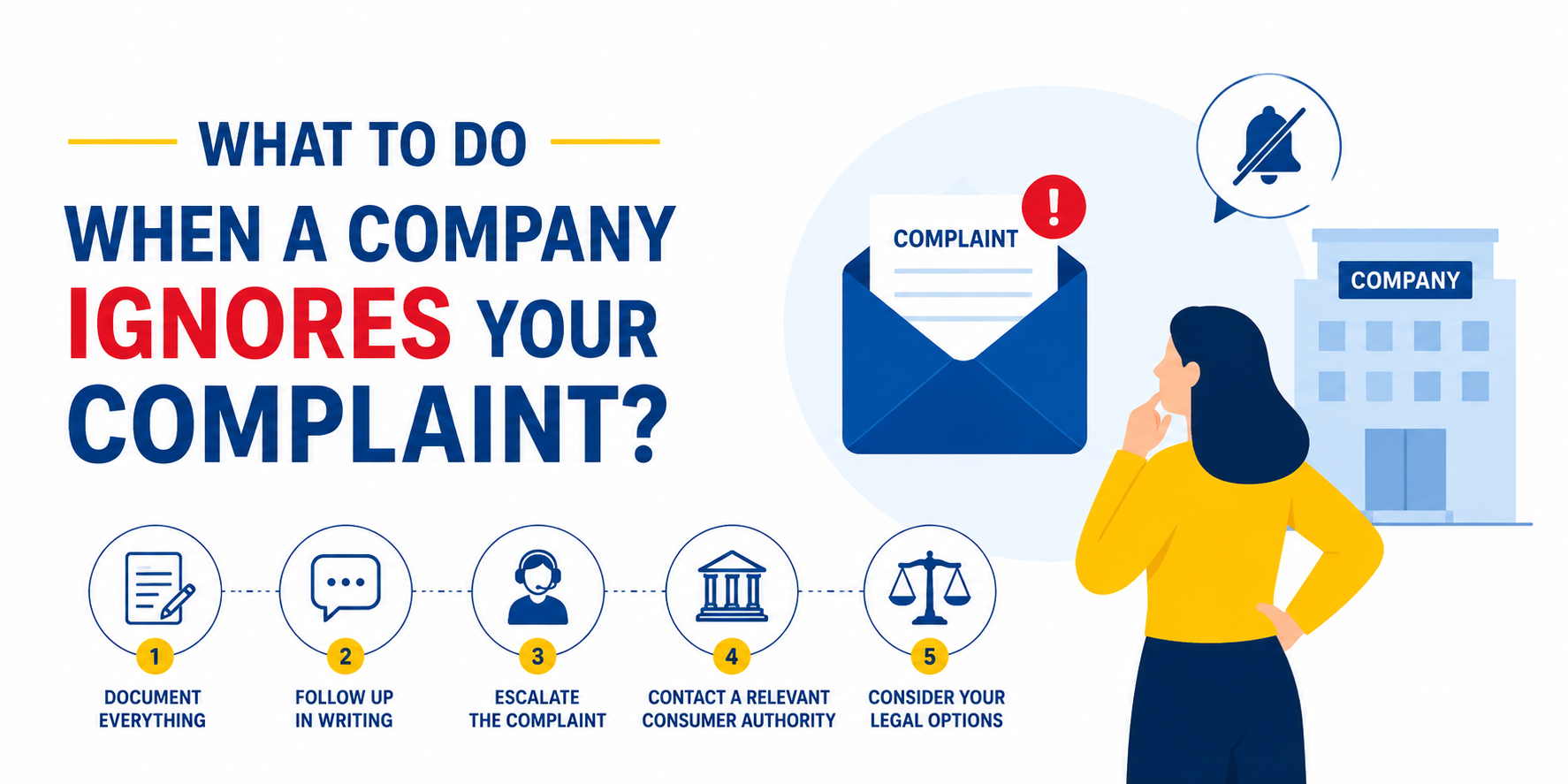
Here’s a proven escalation path to follow when customer support isn’t responding.
Step 1: Review Your Original Complaint
Before sending a follow-up, take a fresh look at what you originally submitted. Ask yourself:
- Did you clearly explain the problem with specific dates, amounts, and events?
- Did you include your supporting evidence such as receipts, screenshots, or order confirmations?
- Did you provide accurate contact information so the company can reach you?
- Did you receive a reference or ticket number? If so, note it for future correspondence.
Sometimes complaints are deprioritized simply because they lack detail. A clear, well-documented complaint is harder to ignore.
Step 2: Send a Professional Follow-Up
A calm, professional follow-up is often all it takes to get a response. Here’s how to approach each channel:
- Email: Reply to your original complaint thread and include your ticket or reference number. Keep the tone firm but polite. State that you are following up and request a response within a specific timeframe.
- Phone: Call the customer service line and ask to speak with someone who can help resolve your case. Reference your previous complaint and ask for the name and employee ID of the person you speak with.
- Social Media: Many companies respond faster to public messages. Tweet the company’s support account or post on their Facebook page. Keep it factual and professional.
- Contact Forms: If email hasn’t worked, try submitting through the company’s official contact form to create a new record of your complaint.
Step 3: Escalate to a Supervisor or Management Team
If front-line customer service isn’t getting you anywhere, escalate. Ask specifically to speak with:
- A team supervisor or manager
- The customer experience or complaint escalation department
- An executive contact (often reachable via LinkedIn or the company’s “About Us” or “Leadership” pages)
For written escalations, address your letter or email to a named executive — a VP of Customer Experience, the CEO of a small company, or a Head of Operations. A direct, professional message to leadership often gets more traction than a generic support ticket.
Step 4: Keep Detailed Records of Everything
From this point forward, document every single interaction. Your records may become essential if you need to involve a consumer protection agency, dispute a charge, or take legal action. Keep track of:
- Dates and times of all calls, emails, and messages
- Names and employee IDs of anyone you speak with
- Copies of all emails and written correspondence
- Screenshots of chat logs, social media conversations, or website errors
- Any responses you receive — even automated ones
Think of your documentation as building a case file. The more organized your records, the stronger your position.
Step 5: Use a Public Complaint Platform
Public visibility can be surprisingly effective when a business has stopped responding through private channels. When a complaint is publicly visible, it creates reputational accountability that many businesses take seriously.
RaiseAComplaint.com is a consumer complaint platform designed to give Americans a transparent space to share their experiences, raise concerns about unresponsive businesses, and help other consumers make informed decisions. Posting your complaint publicly can encourage businesses to engage directly and work toward resolution — especially when they can see that other consumers are reading about their handling of the issue.
Platforms like these also serve a broader purpose: they help warn other consumers, build a public record of business behavior, and add credibility to your complaint if you later involve a regulator.
Step 6: Contact Consumer Protection Agencies
If a business continues to ignore your complaint, escalating to a regulatory or oversight body is your next step. Here are the key agencies to consider:
- State Consumer Protection Offices: Every U.S. state has a consumer protection division, typically under the state Attorney General’s office. These agencies can investigate complaints and, in some cases, take enforcement action against businesses.
- Better Business Bureau (BBB): Filing a complaint with the BBB at bbb.org creates a formal public record. Many businesses respond to BBB complaints because BBB ratings matter to their reputation.
- Federal Trade Commission (FTC): Report fraud, deceptive business practices, and consumer rights violations at ReportFraud.ftc.gov. The FTC uses complaint data to build cases against companies engaging in widespread misconduct.
- Industry-Specific Regulators: Telecom issues go to the FCC. Financial complaints go to the CFPB (Consumer Financial Protection Bureau). Airline complaints go to the DOT. Identifying the right agency for your industry can significantly speed up resolution.
Step 7: Consider a Credit Card Dispute or Chargeback
If your complaint involves a payment — a charge you didn’t authorize, a product that never arrived, or a service that wasn’t delivered as promised — a credit card chargeback may be your fastest path to a refund.
Contact your card issuer and explain the situation. Under the Fair Credit Billing Act (FCBA), you have the right to dispute billing errors and charges for goods or services not received as agreed. Most card issuers give you 60 days from the statement date to initiate a dispute. Keep in mind that chargebacks are a consumer protection tool, not a shortcut — use them when you’ve genuinely made good-faith efforts to resolve the issue first.
Related reading: Chargeback vs Refund: What’s the Difference? | How to Dispute Unauthorized Charges
Step 8: Explore Legal Remedies
For significant financial losses or persistent bad-faith behavior from a business, legal options are worth considering:
- Small Claims Court: For disputes involving smaller amounts of money (typically under $10,000, though limits vary by state), small claims court is an accessible and relatively low-cost option. You don’t need an attorney, and the process is designed for everyday consumers.
- Mediation: A neutral third-party mediator can help both sides reach a resolution without going to court. It’s faster and less expensive than litigation.
- Arbitration: Many consumer contracts include mandatory arbitration clauses. Check your service agreement to understand what dispute resolution process applies to your situation.
- Legal Consultation: For complex disputes involving large sums, consider consulting a consumer rights attorney. Many offer free initial consultations, and some take cases on contingency.
Warning Signs a Company May Never Voluntarily Respond
Not every business will eventually come around. Here are red flags that suggest a company has no intention of resolving your complaint:
- You have sent multiple follow-ups across different channels with no response
- Their support phone lines have been disconnected or consistently go to voicemail
- You only receive generic automated replies that don’t address your specific issue
- A quick search reveals a pattern of identical complaints from other consumers with no resolution
- The company’s website, social media, or business listings show signs of inactivity or closure
If you’re seeing these warning signs, skip directly to consumer protection agencies and legal remedies. Don’t waste more time hoping a non-responsive business will suddenly change course.
Common Mistakes Consumers Make When Complaining
The way you handle a complaint can significantly affect the outcome. Avoid these common missteps:
- Sending emotional or aggressive messages: Anger is understandable, but threatening or insulting language gives companies grounds to dismiss your complaint and can hurt you if the dispute escalates.
- Making vague threats without follow-through: Saying “I’ll sue you” without the intent or preparation to do so undermines your credibility.
- Failing to provide evidence: A complaint without documentation is easy to deny. Always attach receipts, screenshots, and records.
- Posting inaccurate information: Stick to the facts. Exaggerating or misrepresenting what happened can expose you to legal liability and weaken your case.
- Giving up too early: Many consumers abandon a complaint after one or two attempts. Persistence — within professional limits — is often the deciding factor in whether a complaint gets resolved.
Best Practices for Faster Complaint Resolution
Improve your chances of a quick resolution from the start with these practical tips:
- Use the right channel: Identify which channel the company is most responsive on — some businesses prioritize social media, others email, others phone.
- Be specific and concise: State exactly what happened, what you want, and by when. A clear complaint is easier to action than a vague one.
- Reference your consumer rights: Citing relevant laws (FCBA, FDCPA, FCRA) signals that you know your rights and are serious about resolution.
- Set a firm but reasonable deadline: Give the company a specific timeframe to respond (e.g., 5 business days) and state what you’ll do next if they don’t.
- Stay consistent: Use the same complaint reference number, account information, and details across all channels so your case is easy to locate.
- Follow up in writing: Even if you called, follow up with an email summarizing what was discussed. Written records are essential.
How RaiseAComplaint.com Helps Consumers
RaiseAComplaint.com was built for exactly these situations — when consumers have been ignored, dismissed, or left without answers. The platform provides a transparent, public space where you can:
- Share your experience and complaint in your own words
- Raise concerns about businesses that have failed to respond or resolve issues
- Help other consumers by making your experience part of the public record
- Encourage businesses to engage, respond, and address consumer concerns directly
Public accountability matters. When a business sees a complaint posted on a visible consumer platform, it creates a different kind of urgency than a support ticket buried in a queue. Many consumers find that posting publicly — after private channels have failed — is the step that finally gets a response.
Whether you are dealing with a billing dispute, a subscription you can’t cancel, a product that never arrived, or a service that didn’t deliver, RaiseAComplaint.com gives your complaint the visibility it deserves.
The Bottom Line: Don’t Let Your Complaint Be Ignored
Being ignored by a company is frustrating — but it doesn’t have to be the end of the story. The steps in this guide give you a clear, structured path from a polite follow-up all the way to regulatory action and legal remedies if necessary.
The most important things to remember:
- Stay calm and professional in all communications
- Document everything from the very beginning
- Use every channel available — email, phone, social media, and public complaint platforms
- Escalate when private efforts fail, starting with the BBB and FTC
- Know your legal options, including chargebacks, small claims court, and mediation
Persistent, well-documented consumers get results far more often than those who give up after the first attempt. If you have been ignored, use the tools available to you — including RaiseAComplaint.com — to make your voice heard.
Frequently Asked Questions
What should I do if a company doesn’t respond to my complaint?
Start by sending a professional follow-up via email or phone, referencing your original complaint. If you still don’t hear back, escalate to a supervisor, post a public complaint on a platform like RaiseAComplaint.com, and consider filing with the BBB, FTC, or your state’s consumer protection office.
How many times should I follow up with a company?
Two to three well-spaced follow-ups are reasonable before escalating. Send the first follow-up after the standard response window for your industry has passed. If the second and third follow-ups go unanswered, move on to formal escalation channels.
When should I escalate a complaint?
Escalate when the company has missed its reasonable response window, when follow-ups are ignored, or when the responses you receive don’t address your actual issue. You should also escalate immediately if the matter involves fraud, significant financial loss, or a potential safety issue.
Can I report a company for ignoring complaints?
Yes. You can file a complaint with your state’s Attorney General office, the Better Business Bureau, the Federal Trade Commission, or an industry-specific regulator such as the CFPB (finance), FCC (telecom), or DOT (travel). These agencies track complaint patterns and can take action against businesses with repeated violations.
Can a public complaint help me get a response?
Often, yes. Public complaints on consumer platforms create reputational accountability. Many businesses that ignore private support tickets respond quickly when a complaint is visible to potential customers. Sites like RaiseAComplaint.com give your complaint public visibility without requiring legal action.