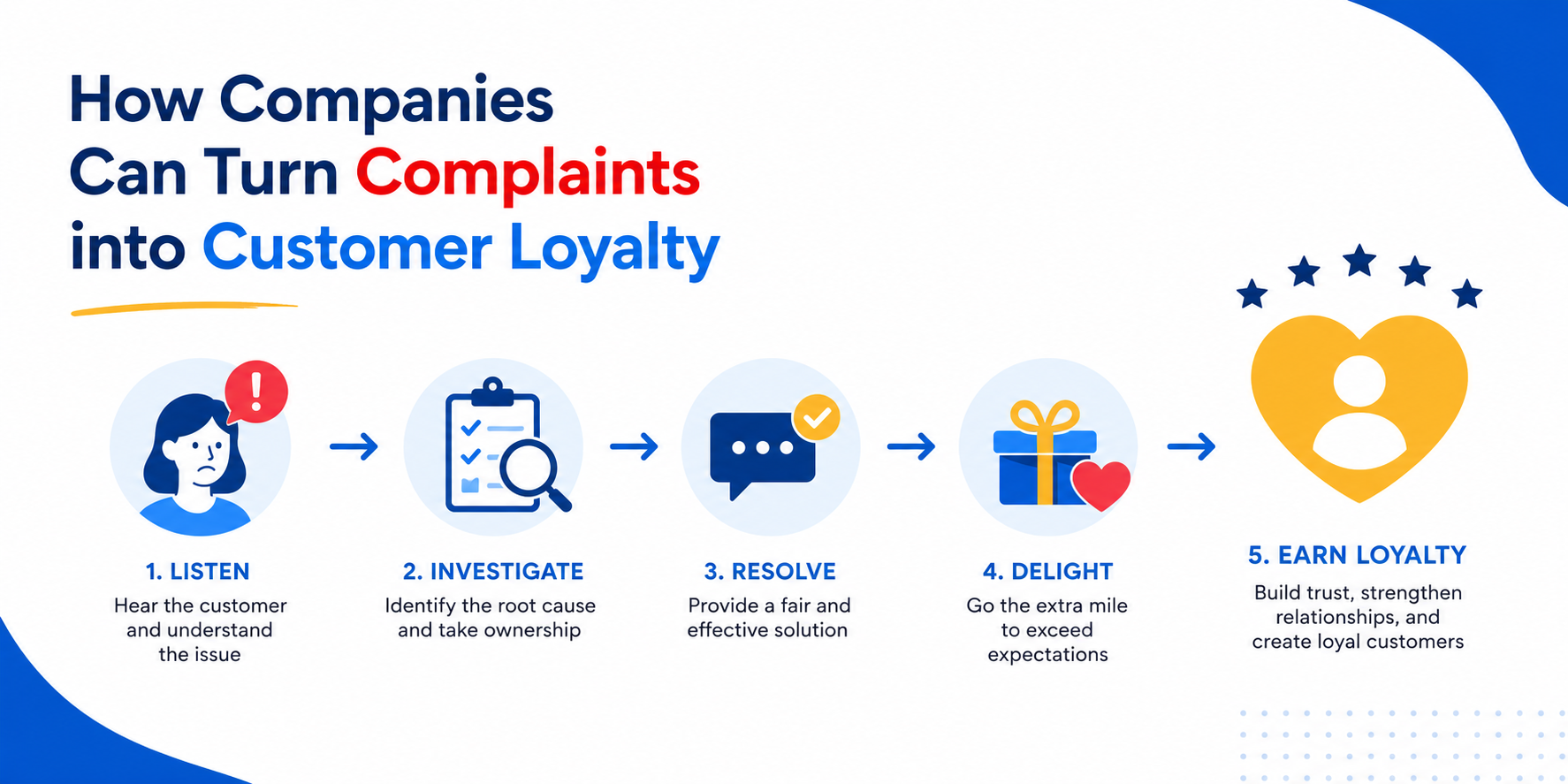
Most businesses approach customer complaints with a sense of dread. A complaint feels like criticism, a failure, a problem that needs to be managed and moved past as quickly as possible. But the companies that consistently build long-term customer loyalty tend to see complaints very differently. They treat them not as inconveniences but as invitations—an honest, unfiltered signal from someone who still cares enough to engage. In fact, handled well, a customer complaint can be the foundation of a relationship far stronger than if the problem had never occurred in the first place. The key is knowing how to respond. How Companies Can Turn Complaints into Customer Loyalty
Why Customer Complaints Are More Valuable Than Most Businesses Realize
There is a common misconception that a business with few visible complaints is a healthy one. In reality, the absence of complaints often indicates the absence of communication—not the absence of problems.
Studies have consistently found that for every customer who complains, many more simply leave. They disengage, take their spending elsewhere, and sometimes share their frustration with friends, family, or online communities without ever giving the business a chance to respond. These silent customers represent an enormous blind spot. They do not give businesses the opportunity to improve, and they erode revenue quietly and steadily.
The customer who complains is, in a meaningful sense, doing the business a favor. They are providing real, specific, actionable feedback that often reveals process failures, communication gaps, or product issues that would otherwise go undetected. Beyond that, a complaint is an act of continued engagement—the customer has not yet fully walked away. There is still a relationship to protect.
Customer feedback gathered through complaints has driven some of the most significant improvements in product design, service delivery, and operational efficiency across industries. Companies that create accessible feedback channels and respond to them seriously gain a distinct advantage: they improve faster, lose fewer customers, and build a reputation for accountability.
Understanding the Link Between Complaint Resolution and Customer Loyalty
One of the most well-documented phenomena in customer service research is the Service Recovery Paradox. It describes a situation in which customers who experience a problem that is then resolved well end up more satisfied—and more loyal—than customers who never had a problem at all.
The paradox exists because a successful complaint resolution is a powerful trust-building event. It demonstrates that the business is genuinely committed to the customer’s experience, not just their initial purchase. When a company handles a complaint with speed, empathy, and fairness, it creates an emotional impression that routine positive interactions rarely produce.
This does not mean businesses should deliberately create problems just to resolve them spectacularly. It does mean that every complaint is a high-stakes moment—one in which the business can either deepen the relationship or sever it permanently.
Common Reasons Customers Complain
Understanding why customers complain is the first step toward preventing and resolving issues effectively. The most common drivers of customer complaints include:
- Poor customer service: Rude, unhelpful, or inconsistent responses from support teams.
- Billing errors: Unexpected charges, duplicate transactions, or unclear invoicing.
- Delayed or failed deliveries: Products arriving late, damaged, or not at all.
- Product defects: Items that do not perform as described or advertised.
- Communication failures: Lack of updates, conflicting information, or ignored inquiries.
- Unmet expectations: When the actual product or service does not match what was promised.
Each of these categories points to a specific operational or communication failure. Viewed this way, complaints become a diagnostic tool—a way of identifying exactly where the customer experience is breaking down.
How Companies Can Turn Complaints Into Customer Loyalty: A Step-by-Step Framework
Turning a dissatisfied customer into a loyal one is not accidental. It requires a clear, consistent approach. The following seven-step framework gives businesses a practical structure for complaint resolution that builds trust at every stage.
1. Respond Quickly
Response time is one of the most significant factors in complaint satisfaction. Customers who contact a business with a problem are often already frustrated, and a slow or absent response amplifies that frustration significantly. Aim to acknowledge every complaint within a few hours and provide a substantive response within 24 hours. Even if the full resolution takes longer, a prompt acknowledgment demonstrates that the complaint has been received and is being taken seriously.
2. Listen Without Becoming Defensive
When a customer complains, the instinct to explain or justify can be strong—especially when the business believes the complaint is unfair or based on a misunderstanding. Resist this instinct. Before offering any explanation or solution, listen fully to what the customer is saying. Active listening means reflecting back what you have heard, asking clarifying questions, and demonstrating genuine empathy for the customer’s experience. Defensiveness shuts down communication; empathy opens it.
3. Acknowledge the Problem
Acknowledging a complaint is not the same as admitting fault. It is a simple, powerful statement that the customer’s experience was not what it should have been. A genuine acknowledgment reduces emotional intensity, signals respect, and creates the psychological space needed to move toward resolution. Phrases like “I understand why this was frustrating” or “This is not the experience we want you to have” can significantly change the tone of an interaction.
4. Offer Practical Solutions
Once the problem is clearly understood and acknowledged, the focus should shift to resolution. Effective solutions are practical, proportionate, and prompt. Depending on the situation, this might mean a refund, a replacement, a credit, a service upgrade, or simply a corrective action and a clear explanation of what will be different going forward. Offer options where possible—giving the customer some control over the resolution increases their sense of fairness and satisfaction.
5. Follow Up After Resolution
A follow-up message after a complaint has been resolved is one of the simplest and most underused trust-building actions available to businesses. It shows that the company’s concern for the customer did not end at resolution, and it provides an opportunity to confirm that the customer is genuinely satisfied. A brief email or call a few days after the resolution can turn a neutralized complaint into a genuinely positive impression.
6. Learn From Recurring Complaints
Individual complaints reveal individual incidents. Recurring complaints reveal systemic problems. Businesses that track complaint patterns over time can identify the root causes of dissatisfaction and address them structurally—improving processes, updating communications, retraining teams, or redesigning products. This is where complaint handling transitions from customer service to operational strategy.
7. Empower Customer Service Teams
One of the most frequent frustrations for customers dealing with complaints is the sense that the person they are speaking to cannot actually do anything. Empowering frontline customer service agents with the authority to offer solutions—without requiring multiple levels of approval—dramatically improves complaint resolution speed and customer satisfaction. Training, clear guidelines, and genuine decision-making authority are essential.
The Cost of Ignoring Customer Complaints
The cost of a poorly handled or ignored complaint extends far beyond a single lost customer. Businesses that develop a reputation for unresponsiveness face a compounding set of consequences:
- Negative reviews: Frustrated customers turn to Google, Yelp, Trustpilot, and platforms like RaiseAComplaint.com to share their experiences publicly.
- Customer churn: Customers who do not receive a response simply leave—and rarely return.
- Lost revenue: Acquiring a new customer costs significantly more than retaining an existing one. Each customer lost to a bad experience represents a substantial long-term revenue loss.
- Reputation damage: A pattern of ignored complaints shapes public perception and makes it harder to attract new customers.
- Social media backlash: A single unresolved complaint that reaches a wide audience can trigger viral negative coverage that is difficult and expensive to address.
The research is unambiguous: businesses that invest in complaint resolution outperform those that do not, on both customer retention and overall profitability.
How Online Reviews Influence Customer Loyalty
In the digital economy, a business’s reputation is partly written by its customers—and that writing is public, searchable, and permanent. Online reviews are one of the first things prospective customers check before making a purchasing decision. The way a business responds to negative reviews is just as important as the reviews themselves.
A thoughtful, respectful public response to a complaint demonstrates several things to future customers: that the business takes accountability seriously, that it communicates professionally under pressure, and that it treats customers as people rather than transactions. In this sense, online complaint responses function as trust signals for an audience far larger than the individual customer involved.
Businesses that engage constructively with negative feedback on review platforms consistently generate stronger brand perception than those that ignore it or respond defensively. Transparency is not just an ethical value—it is a commercial one.
Complaint Management Best Practices for Businesses
Implementing effective complaint management does not require a large team or complex technology. The following practices can be implemented immediately:
- Centralize complaint tracking: Use a single system—even a simple spreadsheet—to log all complaints, their status, and their resolution.
- Set and communicate response standards: Define how quickly complaints will be acknowledged and resolved, and share these standards publicly.
- Respond on the channel where the complaint was raised: If the customer complained on social media, respond there—not just by email.
- Personalize every response: Generic, template-driven replies signal indifference. Use the customer’s name, reference their specific issue, and tailor every response.
- Analyze complaint data monthly: Review complaint categories, volume, and resolution rates to identify trends and improvement opportunities.
- Close the loop internally: Share complaint insights with relevant teams—product, operations, marketing—so that the learning is embedded in the organization.
How Public Complaint Platforms Can Benefit Businesses
Platforms like RaiseAComplaint.com provide businesses with something genuinely valuable: a structured, public environment for demonstrating accountability. When a customer raises a complaint on a public platform, it may initially feel threatening—but the opportunity it creates is significant.
A business that monitors complaint platforms and responds promptly and constructively to negative feedback sends a powerful message to all potential customers who read those exchanges. It signals that the company is confident in its service standards, willing to engage honestly with criticism, and genuinely committed to resolution rather than reputation management.
Public complaint platforms also provide businesses with aggregated feedback that internal channels may not capture—particularly from customers who felt they had no other avenue for being heard. By engaging with this feedback, companies access insights that can drive meaningful operational improvement. The businesses that benefit most from platforms like RaiseAComplaint.com are those that treat them not as threats to be managed, but as channels to be monitored and engaged with thoughtfully.
The Bottom Line
Every complaint is a decision point. Handled poorly, it accelerates a customer’s departure and potentially damages the business’s reputation with everyone that customer influences. Handled well, it creates an opportunity to demonstrate values that are impossible to fake: accountability, empathy, and genuine commitment to service.
The businesses that build the strongest, most enduring customer loyalty are rarely those with the fewest complaints—they are the ones that have learned to handle complaints better than anyone else. They have built the processes, developed the teams, and cultivated the culture that turns difficult moments into defining ones.
For business owners and customer service leaders looking to strengthen their approach, the starting point is simple: the next complaint that arrives is not a problem. It is an invitation. Accept it.
Frequently Asked Questions
Why are customer complaints important for businesses?
Customer complaints provide direct, actionable feedback that businesses cannot easily gather any other way. They reveal operational failures, communication gaps, and unmet expectations—information that is essential for improvement. More importantly, they represent continued engagement from customers who have not yet fully walked away, giving businesses a genuine opportunity to recover the relationship.
Can complaints actually improve customer loyalty?
Yes, and the evidence is substantial. The Service Recovery Paradox demonstrates that customers whose complaints are resolved quickly and effectively often become more loyal than customers who never had a problem. A well-handled complaint proves that the business genuinely cares about the customer’s experience—something that routine positive interactions rarely demonstrate so clearly.
What is the Service Recovery Paradox?
The Service Recovery Paradox is a well-documented customer service phenomenon in which a customer’s satisfaction and loyalty following an effective complaint resolution exceeds their satisfaction levels prior to the problem occurring. It occurs because successful resolution demonstrates genuine commitment to customer experience, creating a trust-building event that is more emotionally impactful than ordinary positive interactions.
How quickly should a business respond to a complaint?
Best practice is to acknowledge every complaint within a few hours of receipt and provide a substantive, personalized response within 24 hours. For complaints raised on social media or public platforms, faster responses are even more important. Extended delays signal indifference and give dissatisfied customers time to escalate, disengage, or share their frustration publicly.
How do negative reviews affect customer trust?
Negative reviews influence purchasing decisions significantly—both directly, by shaping impressions of the business, and indirectly, through how the business responds publicly. A thoughtful, accountable public response to a negative review can actually strengthen prospective customer trust by demonstrating that the business takes feedback seriously and engages honestly with criticism rather than ignoring it.
What should a business do after resolving a complaint?
After resolving a complaint, businesses should send a follow-up message—typically within 48 to 72 hours—to confirm that the customer is genuinely satisfied with the outcome. This follow-up converts a neutralized complaint into a positive impression and signals that the company’s concern for the customer extends beyond the transaction. It is also an opportunity to invite the customer to share their experience publicly if they feel comfortable doing so.
Can public complaint responses improve business reputation?
Yes. Public responses to complaints on review platforms and complaint sites are visible to all future customers who research the business. A professional, empathetic, and solution-oriented public response demonstrates accountability and communicates service quality to a much wider audience than the original complainant. Over time, a consistent pattern of constructive public engagement builds a reputation for reliability and transparency.
How can businesses prevent complaints from recurring?
Preventing recurring complaints requires tracking complaint categories over time to identify patterns, conducting root cause analysis for the most frequent issues, and implementing structural fixes—updating processes, improving communications, retraining teams, or redesigning products. Monthly complaint reviews shared across relevant departments ensure that the insights generated by individual customer interactions drive lasting operational improvement.
What is the biggest mistake businesses make with complaints?
The most damaging mistake is failing to respond at all—whether to an individual complaint or to a public review. Unanswered complaints are interpreted as indifference, both by the affected customer and by anyone who observes the non-response publicly. Silence is not neutral. It actively damages customer trust and business reputation in ways that are far harder to reverse than a single negative interaction.
How does complaint management relate to customer retention?
Complaint management is one of the most cost-effective customer retention tools available to businesses. Retaining an existing customer costs significantly less than acquiring a new one, and effective complaint resolution directly reduces churn by converting dissatisfied customers into loyal ones. Businesses with strong complaint resolution processes consistently achieve higher retention rates and stronger long-term profitability than those without.