
Buying a product or service does not always go as planned. A delivery may arrive late, a bill may contain an unexpected charge, a product may fail to meet expectations, or a business may handle a question poorly. In these situations, consumers often wonder whether they should write a review, make a complaint, or do both.
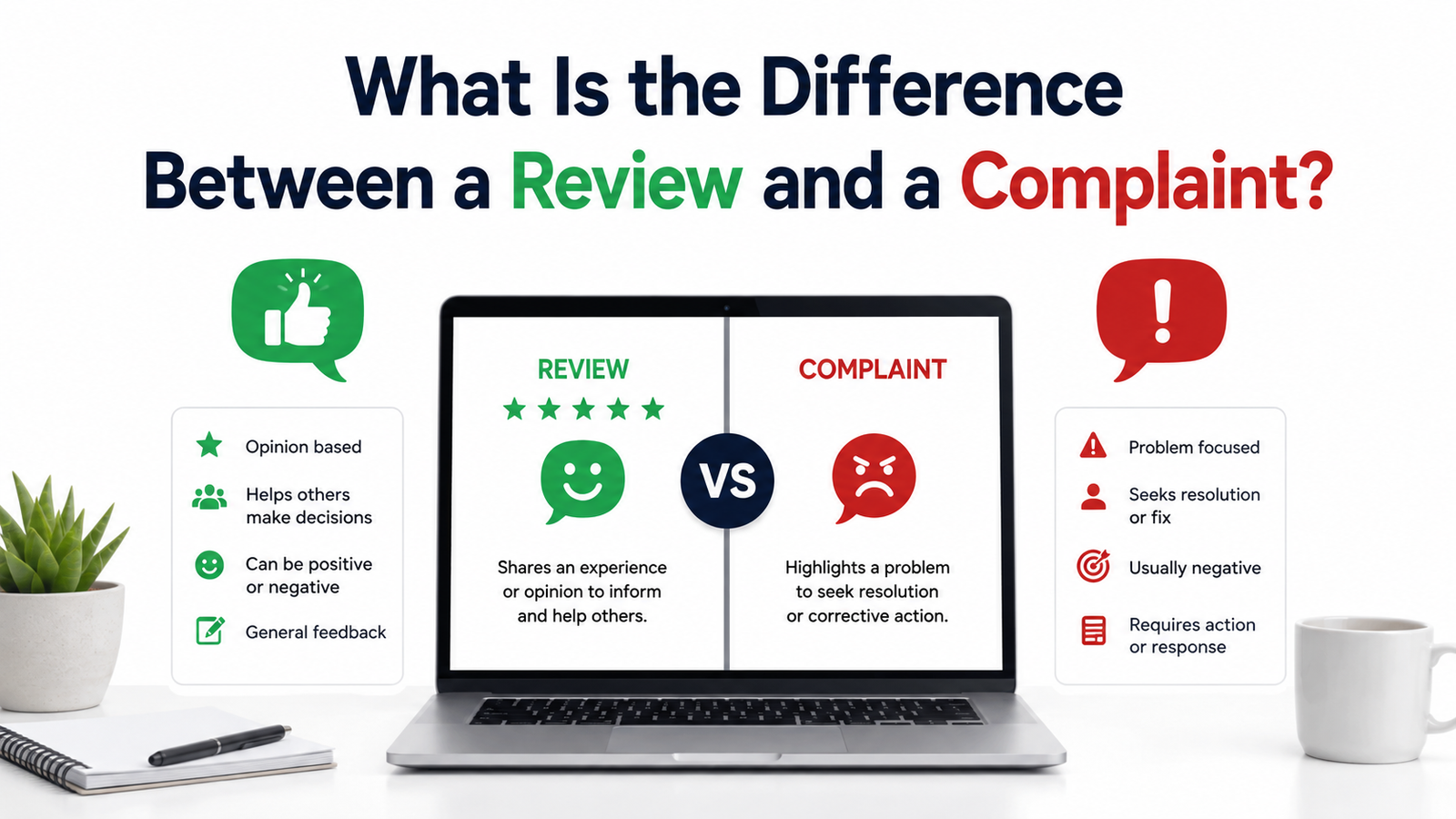
The difference between a review and a complaint mainly comes down to purpose. A review shares a consumer’s experience with a company, product, or service so other people can understand what to expect. A complaint focuses on a particular problem or dissatisfaction and may seek an explanation, correction, refund, replacement, or another resolution. The two can overlap, but they do not always serve the same purpose.
Understanding this distinction makes it easier to communicate clearly and helps other consumers understand whether they are reading a general opinion or an account of an unresolved issue.
What Is a Consumer Review?
A consumer review is a first-hand account of someone’s experience with a product, service, business, or brand. Reviews can be positive, negative, or mixed. They may describe what a consumer expected, what actually happened, and whether the experience matched those expectations.
For example, someone might post an online review after buying a laptop. They could mention that it arrived quickly, worked as described, and offered good value. Another customer might describe the same product differently because it developed a fault soon after purchase.
A review does not necessarily ask the company to take action. Its main purpose is often to inform other consumers. Details about the purchase, service quality, communication, problems, and outcome can make a customer review much more useful than a short statement such as “great” or “terrible.”
A review may also be updated. If a company responds or a problem is resolved, the consumer can add that information to give readers a more complete picture of the experience.
What Is a Consumer Complaint?
A consumer complaint is a statement that a consumer is dissatisfied with a company, product, or service because of a specific issue. The focus is usually on something that went wrong and needs attention.
Common examples include an incorrect charge, a missing order, a defective product, an unexpected subscription fee, a delayed refund, a cancellation issue, or poor customer service.
Suppose a customer orders a phone online but receives the wrong model. The person may want the correct product, a refund, or an explanation. A complaint about a company would focus on what happened, what communication has already taken place, and what outcome the consumer is seeking.
A complaint is therefore often more action-oriented than a review. It can also become useful information for other consumers, especially when it describes a specific problem clearly.
What Is the Difference Between a Review and a Complaint?
The clearest way to understand the difference between a review and a complaint is to consider the question each one answers.
- A review essentially asks: “What was my experience with this company, product, or service?”
- A complaint asks: “What went wrong, and can this issue be addressed?”
There are several practical differences.
- Purpose: A review primarily shares an experience with other consumers. A complaint primarily raises a problem or dissatisfaction.
- Focus: A review can describe the overall customer journey. A complaint usually concentrates on one or more specific issues.
- Desired outcome: A review may request no action. A complaint may seek a refund, correction, explanation, replacement, cancellation, or another reasonable outcome.
- Audience: Reviews are especially useful to future customers. Complaints can be directed toward a company while also informing other consumers.
- Timing: A review can be written after an experience at almost any point. A complaint is often made when there is an unresolved issue.
These are useful general distinctions rather than strict rules. A single post can be both a review and a complaint when it describes the experience and raises a specific problem.
Is a Negative Review the Same as a Complaint?
Not necessarily. A negative review describes an unsatisfactory experience, but it does not always ask the company to do something.
For example, a customer may write that a delivery was late, the packaging was damaged, and the product quality was disappointing. That is a negative assessment of the experience.
A complaint could describe those same events but add a request for action, such as asking for a replacement or refund.
The line between the two can be blurred. A review may contain a complaint, while a complaint may also help other consumers decide whether to use a company. The important point is to make the purpose of the post clear and keep the information accurate.
When Should You Write a Review?
Writing a consumer review makes sense when your main goal is to share an experience that could help other people make an informed decision.
You might review a company after a positive purchase, a disappointing experience, or a mixed experience. Reviews can be particularly useful when you want to describe product quality, customer service, delivery, communication, value, or whether expectations were met.
A review does not have to be positive to be useful. A critical review can be valuable when it explains what happened, provides context, and avoids unproven claims.
When Should You Make a Complaint?
A consumer complaint is more appropriate when there is a specific issue you want raised or addressed.
Examples include an incorrect charge, a damaged or missing product, an unexpected fee, difficulty cancelling a service, a delayed refund, or repeated problems with customer service.
When making a complaint, explain what happened and what outcome would reasonably address the issue. Dates, order details, relevant communication, and a clear description of the problem can make the complaint easier to understand.
Avoid relying on insults, assumptions, or exaggerated statements. Specific facts are more useful than emotional language alone.
Can You Write Both a Review and a Complaint?
Yes. The two can serve different purposes.
Imagine that a customer receives a damaged appliance. The consumer contacts the company to request a replacement and also publishes a complaint describing the issue. Later, the consumer could update the post or write a review about the overall experience, including how the matter was handled.
The key is to keep each post accurate and avoid duplicating information simply to create multiple entries. A review can focus on the broader experience, while a complaint can focus more closely on the problem.
Should You Contact a Company Before Writing a Review or Complaint?
There is no single approach for every situation, but contacting the company first can sometimes give it an opportunity to understand the issue and respond.
Keep relevant messages, receipts, order information, and other records. These details can help you describe the timeline accurately if you later publish a company complaint or review.
Whatever approach you choose, separate facts from assumptions. State what happened, what was communicated, and what happened afterward.
What Should You Include in a Helpful Consumer Review?
A useful review gives readers enough context to understand the experience.
Include the product or service involved, a general timeframe, what happened, what went well or poorly, how the company responded, and the eventual outcome.
The most useful consumer feedback is specific without revealing unnecessary personal information. Do not publish passwords, full payment details, account numbers, or other sensitive information.
What Should You Include in a Consumer Complaint?
A clear complaint should identify the problem, explain the timeline, and describe previous communication with the company.
For example, instead of saying, “This company is awful,” explain that a payment was taken twice, when it happened, whether you contacted the business, and what happened afterward.
A well-structured customer complaint is easier for readers and businesses to understand. It also keeps the focus on the actual issue rather than emotion.
What Makes a Review or Complaint Credible?
Credibility matters because people often read company reviews and company complaints before deciding whether to buy something.
A credible account is based on first-hand experience and provides enough information to explain the situation. Specific facts, relevant dates, a clear sequence of events, and a distinction between facts and opinions all improve clarity.
Avoid presenting assumptions as proven facts. Describe what you observed and what you can reasonably establish. Respectful language also makes the account easier for others to evaluate.
Why Do Reviews and Complaints Matter to Other Consumers?
Reviews and complaints can provide information that consumers may not get from advertising or a company’s own product descriptions.
One account does not automatically define a business. However, multiple detailed accounts can help readers identify recurring themes involving delivery, billing, product quality, cancellations, communication, or customer service.
This is one reason online reviews can be useful before a purchase. Consumers can compare experiences rather than relying solely on marketing messages.
Complaints can also highlight specific friction points. When similar issues appear across several accounts, readers may have more reason to investigate before making a decision.
How Can Consumers Share Their Experiences Online?
Consumers can use review and complaint platforms to describe their experiences and compare what other customers report.
RaiseAComplaint is one such platform, where consumers can publish reviews, share complaints, communicate with brands, and browse company experiences. Its website also highlights user-generated content, verification and moderation, and opportunities to contact brands.
Its current review pages show a mix of general customer experiences and detailed complaints about issues such as billing, delivery, product problems, and refunds.
For consumers, the value comes from having more experiences to compare rather than relying on one isolated account.
Common Mistakes to Avoid When Writing a Review or Complaint
One common mistake is being too vague. Saying “terrible company” gives readers little useful information. Explain what happened instead.
Another mistake is making accusations without evidence. Strong language can distract from the actual problem and reduce the usefulness of the account.
Consumers should also avoid publishing sensitive personal information. Keep the focus on details that help explain the experience.
Finally, do not assume that one negative experience proves a company always behaves that way. Describe your own experience accurately and let readers consider it alongside other accounts.
Review vs. Complaint: Which One Should You Choose?
Start with your goal. Choose a consumer review when you mainly want to tell other people what your experience was like.
Choose a consumer complaint when you have a specific issue to raise and may want a response or resolution.
Use both when appropriate. You may want to describe a specific problem while also giving future customers a broader account of your experience.
Neither option is automatically better. The right choice depends on what happened, what you want to communicate, and whether your main purpose is to share information, raise an issue, or do both.
Frequently Asked Questions
What is the difference between a review and a complaint?
The difference between a review and a complaint is mainly purpose. A review shares an experience for other consumers, while a complaint focuses on a specific problem or dissatisfaction and may seek a response or resolution.
Is a negative review considered a complaint?
A negative review can contain a complaint, but the terms are not identical. A negative review may simply describe dissatisfaction, while a complaint usually highlights a specific issue and may request action.
Should I write a review or make a complaint?
Write a review when your main goal is to share your experience. Make a complaint when you want to raise a specific problem. In some situations, both can be appropriate.
Can I write a review after making a complaint?
Yes. You can share a review after raising a complaint. The review can describe the broader experience, including how the issue was handled and what the final outcome was.
What should I include in a consumer complaint?
Include relevant product or service details, what happened, important dates, previous communication, and the outcome you are seeking. Keep the information factual and avoid unnecessary personal details.
What makes a consumer review useful?
A useful review is specific, clear, and based on first-hand experience. Details about the product, service, timing, communication, problems, and outcome can make it more helpful to other consumers.