
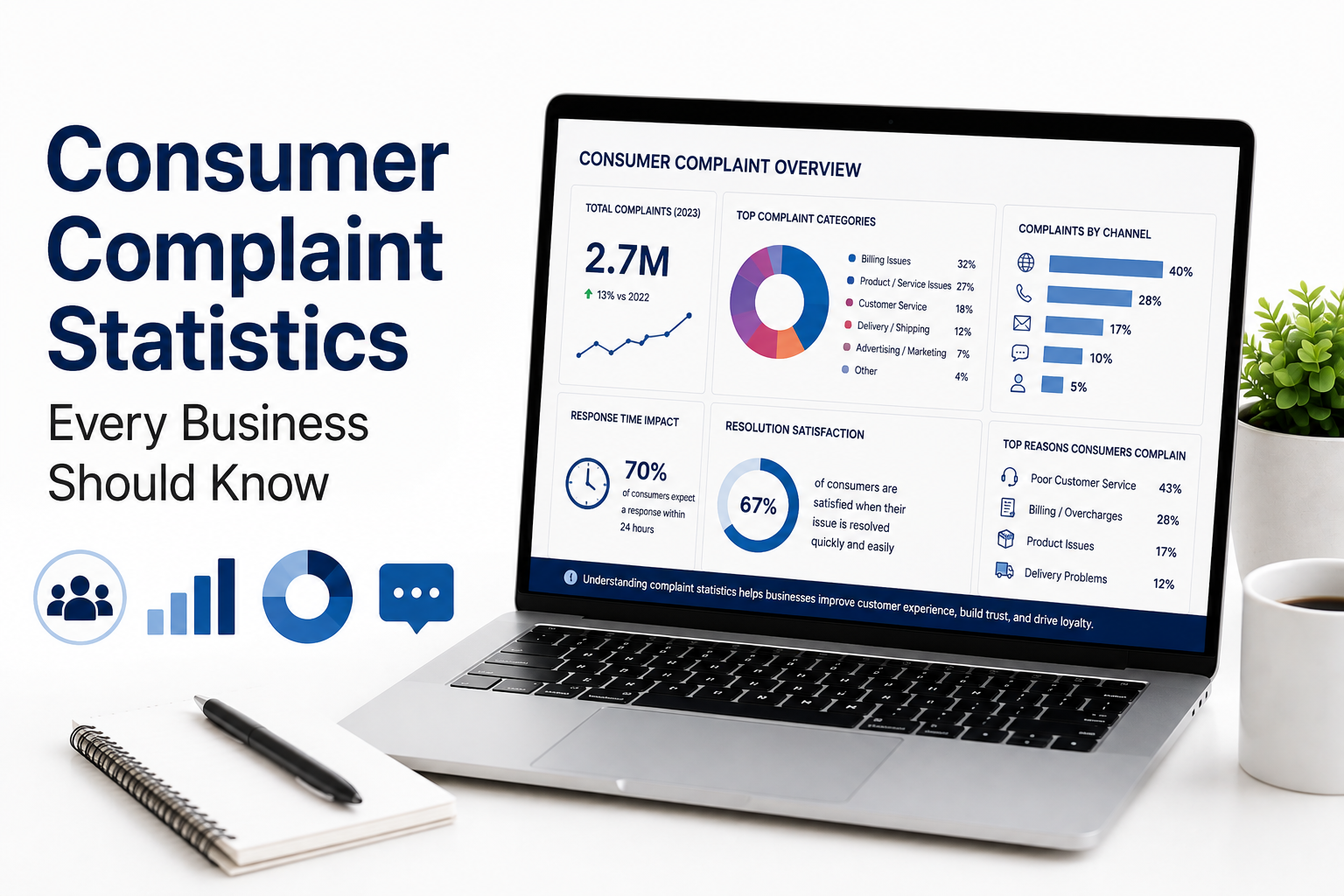
Every complaint a business receives is a data point, not just a customer service ticket. Multiplied across an industry, these data points become consumer complaint statistics that reveal patterns in product quality, support responsiveness, billing accuracy, and communication clarity. Businesses that pay attention to this data get an early warning system for problems that would otherwise surface later as negative reviews, chargebacks, or regulatory complaints. This article breaks down the most recent, verified consumer complaint and customer experience statistics from federal agencies and leading research firms, explains what they mean for day-to-day operations, and outlines practical steps for turning complaint data into a driver of customer retention and business growth.
Why Consumer Complaint Statistics Matter
Customer expectations have shifted from “get it fixed eventually” to “get it fixed now, on my terms.” Zendesk's 2026 CX Trends report, based on surveys of more than 11,000 consumers and CX leaders, found that 74% of consumers now expect service to be available around the clock, and 88% expect faster responses than they did just a year earlier. When those expectations go unmet, businesses don't just lose a single transaction — they risk losing the relationship entirely. Zendesk found that 85% of CX leaders now believe a single unresolved issue is enough to cost a business a customer for good.
Reputation and revenue are directly linked to how complaints get handled. PwC's 2025 Customer Experience Survey found that 52% of consumers have stopped buying from a brand entirely after a bad experience with its products or services, and 29% left specifically because of poor customer experience, either online or in person. Separately, Qualtrics XM Institute's research puts a dollar figure on the problem: roughly $3.7 trillion in global sales is at risk each year because of substandard customer experiences, and about half of dissatisfied customers respond by cutting their spending with that company. How to File an Effective Consumer Complaint
On the positive side, resolving issues well pays off. Salesforce's State of the Connected Customer report found that 88% of customers are more likely to make another purchase when a company meets their service expectations, underscoring that complaint handling isn't just damage control — it's a retention strategy that shapes long-term customer loyalty and business growth.
Key Consumer Complaint Statistics Every Business Should Know
Customer Service Statistics
- 74% of consumers expect 24/7 customer service availability, and 88% expect faster response times than a year ago (Zendesk CX Trends 2026).
- 85% of CX leaders say a single unresolved issue is enough to lose a customer for good (Zendesk CX Trends 2026).
- 83% of consumers believe the customer journey should be significantly better than what they currently experience (Zendesk CX Trends 2026).
- 90% of consumers say customer service is an important factor in their brand choice and loyalty, according to Microsoft's Global State of Customer Service research.
Consumer Complaint Trends
- The CFPB received more than 6.6 million consumer complaints in 2025, up from roughly 3.2 million in 2024 and 1.6 million in 2023 — volume has more than doubled year over year (CFPB, 2025 Consumer Response Annual Report).
- Credit or consumer reporting issues were the most complained-about product category in 2025, representing 88% of all complaints received, or approximately 5.8 million complaints (CFPB).
- The CFPB sent complaints to more than 4,000 companies for review and response in 2025 (CFPB).
- Debt collection complaints totaled more than 207,800 in 2024, with 77% forwarded to companies for a response (CFPB).
Online Review Statistics
- Independent consumer research consistently finds that the large majority of shoppers, commonly cited above 90%, read online reviews before completing a purchase, especially for local businesses and first-time purchases.
- A meaningful share of consumers report trusting online reviews nearly as much as personal recommendations from friends or family, reinforcing how public an unresolved complaint can quickly become.
- Consumer research surveys repeatedly find that businesses which respond to reviews, particularly negative ones, are viewed more favorably than businesses that stay silent.
Unresolved complaints rarely stay private. What starts as a support ticket often becomes a public review, and a public review shapes the next customer's decision long before that customer ever speaks with your team.
Complaint Resolution Statistics
- The CFPB reports that companies responded to more than 99% of complaints sent to them in a timely manner in 2025 (CFPB).
- The CFPB sends 97% of complaints to companies within a day or less of receiving them (CFPB).
- In 88% of credit and consumer reporting complaints, consumers said they first tried to resolve the issue directly with the company before escalating to a regulator (CFPB).
- Companies closed 51% of 2025 credit-reporting complaints with an explanation and 40% with non-monetary relief (CFPB).
Customer Loyalty Statistics
- 88% of customers are more likely to make another purchase when a company meets their service expectations (Salesforce, State of the Connected Customer).
- 65% of customers expect companies to adapt to their changing needs, yet 61% say most companies still treat them like a number (Salesforce).
- Qualtrics XM Institute found that customers who become “promoters” after a good experience are 3.6 times more likely to purchase again than detractors, and 4.4 times more likely to forgive a future mistake.
- Global consumer likelihood to repurchase after a recent experience stood at 69% in 2025, according to Qualtrics XM Institute's Global Consumer Study.
Digital Customer Experience Statistics
- 76% of consumers say they would choose a company that lets them combine text, images, and video in a single support conversation instead of restarting across channels (Zendesk).
- 63% of consumers report that their demand for transparency, including around how companies use AI, has increased compared to the previous year (Zendesk).
- 80% of consumers say the overall experience a company provides is as important as its actual products or services (Salesforce).
- 74% of consumers find it frustrating to repeat their issue to multiple support agents, reinforcing the value of connected support systems (Zendesk).
Table of Important Consumer Complaint Statistics
|
Statistic |
Figure |
Source |
Why It Matters |
|
Consumers who expect 24/7 customer service availability |
74% |
Zendesk CX Trends 2026 |
Always-on support has become a baseline expectation, not a premium feature. |
|
Consumers expecting faster responses than a year ago |
88% |
Zendesk CX Trends 2026 |
Response-time standards keep rising, raising the bar for every support team. |
|
CX leaders who say one unresolved issue costs a customer permanently |
85% |
Zendesk CX Trends 2026 |
First-contact resolution is now a retention issue, not just an efficiency metric. |
|
Consumer complaints received by the CFPB in 2025 |
6.6M+ |
CFPB, 2025 Consumer Response Annual Report |
Complaint volume has more than doubled year over year, signaling rising consumer friction industry-wide. |
|
Share of 2025 CFPB complaints tied to credit or consumer reporting |
88% |
CFPB, 2025 Consumer Response Annual Report |
Shows where regulatory and reputational risk concentrates most heavily. |
|
CFPB complaints companies answered in a timely manner |
99%+ |
CFPB, 2025 Consumer Response Annual Report |
Sets the industry benchmark for what counts as an acceptable response time. |
|
CFPB complaints routed to companies within a day |
97% |
CFPB, 2025 Consumer Response Annual Report |
Fast escalation means slow business responses become visible almost immediately. |
|
Consumers who stopped buying from a brand after a bad experience |
52% |
PwC, 2025 Customer Experience Survey |
Quantifies direct revenue loss tied to poor product or service experiences. |
|
Consumers who left a brand specifically due to poor customer experience |
29% |
PwC, 2025 Customer Experience Survey |
Separates product failures from service and experience failures. |
|
Global sales estimated at risk each year from poor customer experience |
$3.7 trillion |
Qualtrics XM Institute |
Puts a concrete dollar figure on the cost of unresolved customer friction. |
|
Consumers likely to repurchase after a recent experience |
69% |
Qualtrics XM Institute, 2025 Global Consumer Study |
Benchmarks the loyalty payoff of consistently good experiences. |
|
Customers more likely to repurchase when expectations are met |
88% |
Salesforce, State of the Connected Customer |
Ties meeting service expectations directly to repeat revenue. |
|
Customers who feel most companies treat them like a number |
61% |
Salesforce, State of the Connected Customer |
Reveals a widespread personalization and empathy gap businesses can close. |
|
Consumers who say overall experience matters as much as the product itself |
80% |
Salesforce, State of the Connected Customer |
Confirms experience has become a competitive differentiator, not an add-on. |
|
Consumers frustrated by repeating their issue to multiple support agents |
74% |
Zendesk CX Trends 2026 |
Highlights the cost of siloed, disconnected support systems. |
What These Statistics Mean for Businesses
Taken together, these numbers point to a simple operational reality: complaint data is a leading indicator, not a lagging one. Rising CFPB complaint volume shows that friction is building faster than many companies are resolving it. High expectations around 24/7 availability and faster response times mean that outdated support hours or slow escalation paths now register as service failures rather than minor inconveniences.
For business leaders, this translates into a few concrete priorities: closing the personalization gap that leaves 61% of customers feeling like a number, matching complaint response speed to the near-real-time standard set by regulators and CX leaders, and treating repeat complaint themes as product or process signals rather than isolated incidents. Reputation management, employee training, and customer experience investment all become more effective once they're grounded in actual complaint patterns instead of assumptions about what customers want.
How Businesses Can Improve Complaint Management
1. Respond Quickly
Speed sets the tone for the entire interaction. With 88% of consumers now expecting faster responses than a year ago, even a same-day acknowledgment can prevent a complaint from escalating into a public review.
2. Train Customer Support Teams
Support staff need both the authority and the knowledge to resolve issues on first contact, since 85% of CX leaders say one unresolved issue is enough to lose a customer permanently.
3. Track Complaint Trends
Categorizing complaints by root cause turns scattered feedback into a dataset that highlights recurring product, billing, or service issues before they multiply.
4. Encourage Customer Feedback
Proactively inviting feedback surfaces smaller issues before they turn into formal complaints or negative reviews, giving businesses more time to respond.
5. Resolve Issues Transparently
Clear communication about what happened, what's being done, and what to expect next builds trust even when the underlying issue takes time to fully resolve.
6. Monitor Online Reputation
Since most consumers read reviews before purchasing, monitoring and responding to reviews across platforms should be treated as a core support function, not an afterthought.
7. Learn From Complaint Data
Complaint patterns often point directly to specific products, policies, or processes that need to change, making this data one of the most underused planning tools available to operations teams.
Common Mistakes Businesses Make
- Ignoring complaints or treating them as one-off nuisances instead of recurring signals.
- Responding too slowly, which conflicts directly with rising consumer expectations for near-instant acknowledgment.
- Sending generic, templated responses that fail to address the specific issue a customer raised.
- Failing to follow up once a complaint appears resolved, leaving customers uncertain whether the issue was actually fixed.
- Not measuring complaint trends over time, which makes it impossible to tell whether service quality is improving or declining.
How RaiseAComplaint.com Helps Businesses
RaiseAComplaint.com gives businesses a structured, public channel for understanding what customers are actually experiencing. Instead of complaints scattered across emails, social media, and phone calls, businesses can see consumer concerns organized in one place, monitor complaint trends over time, and respond directly and professionally to individual cases. This kind of visibility supports better internal decision-making, helps teams spot recurring issues earlier, and gives businesses a documented way to demonstrate transparency and accountability to current and prospective customers. Using a platform like RaiseAComplaint.com does not guarantee a specific business outcome, but it does give companies a clearer, more organized view of consumer sentiment than relying on scattered channels alone.
The Bottom Line
Consumer complaint statistics tell a consistent story: customers expect fast, transparent, and genuinely helpful responses, and businesses that deliver on those expectations are rewarded with stronger retention and revenue. From CFPB data showing complaint volume more than doubling in a single year, to PwC and Salesforce research linking service quality directly to repurchase behavior, the evidence points in one direction — complaint data is too valuable to ignore. Businesses that treat consumer complaint statistics as an ongoing feedback loop, rather than a once-a-year report, are better positioned to catch problems early, protect their reputation, and turn resolved complaints into long-term customer loyalty.
Frequently Asked Questions
Why are consumer complaint statistics important?
They reveal patterns in product quality, service speed, and communication that individual complaints don't show on their own. Tracking these statistics helps businesses spot recurring problems early, benchmark performance against industry data, and prioritize fixes that protect customer retention and long-term revenue.
What are the most common types of consumer complaints?
According to the CFPB, credit or consumer reporting issues are the most common complaint category, followed by debt collection, credit cards, checking or savings accounts, and money transfers. Outside financial services, billing errors, delayed refunds, and unclear service policies are frequently reported issues.
How quickly should businesses respond to complaints?
As fast as possible. The CFPB routes 97% of complaints to companies within a day, and 88% of consumers now expect faster responses than they did a year ago. Same-day acknowledgment, even before a full resolution, helps prevent escalation.
Do complaints affect customer loyalty?
Yes. Salesforce research found that 88% of customers are more likely to repurchase when their service expectations are met, while PwC found that 52% of consumers stop buying from a brand entirely after a bad experience. How a complaint is handled often matters more than the original issue.
How do online reviews influence buying decisions?
Consumer research consistently shows that most shoppers read reviews before purchasing, particularly for local businesses and unfamiliar brands. Unresolved complaints frequently resurface as negative reviews, making complaint handling a direct factor in future sales.
How can businesses reduce the number of complaints they receive?
Businesses can reduce complaint volume by fixing recurring root causes identified in complaint data, clarifying policies upfront, training support staff to resolve issues on first contact, and following up to confirm a fix actually worked.
What is complaint management?
Complaint management is the structured process of receiving, tracking, resolving, and analyzing customer complaints. Effective complaint management turns individual issues into operational insight, helping businesses improve products, services, and support processes over time.
Can complaint data help with business growth?
Yes. Complaint trends often highlight specific friction points that, once fixed, improve customer retention and word-of-mouth referrals. Businesses that treat complaint data as a planning tool rather than a nuisance tend to build more durable customer relationships.