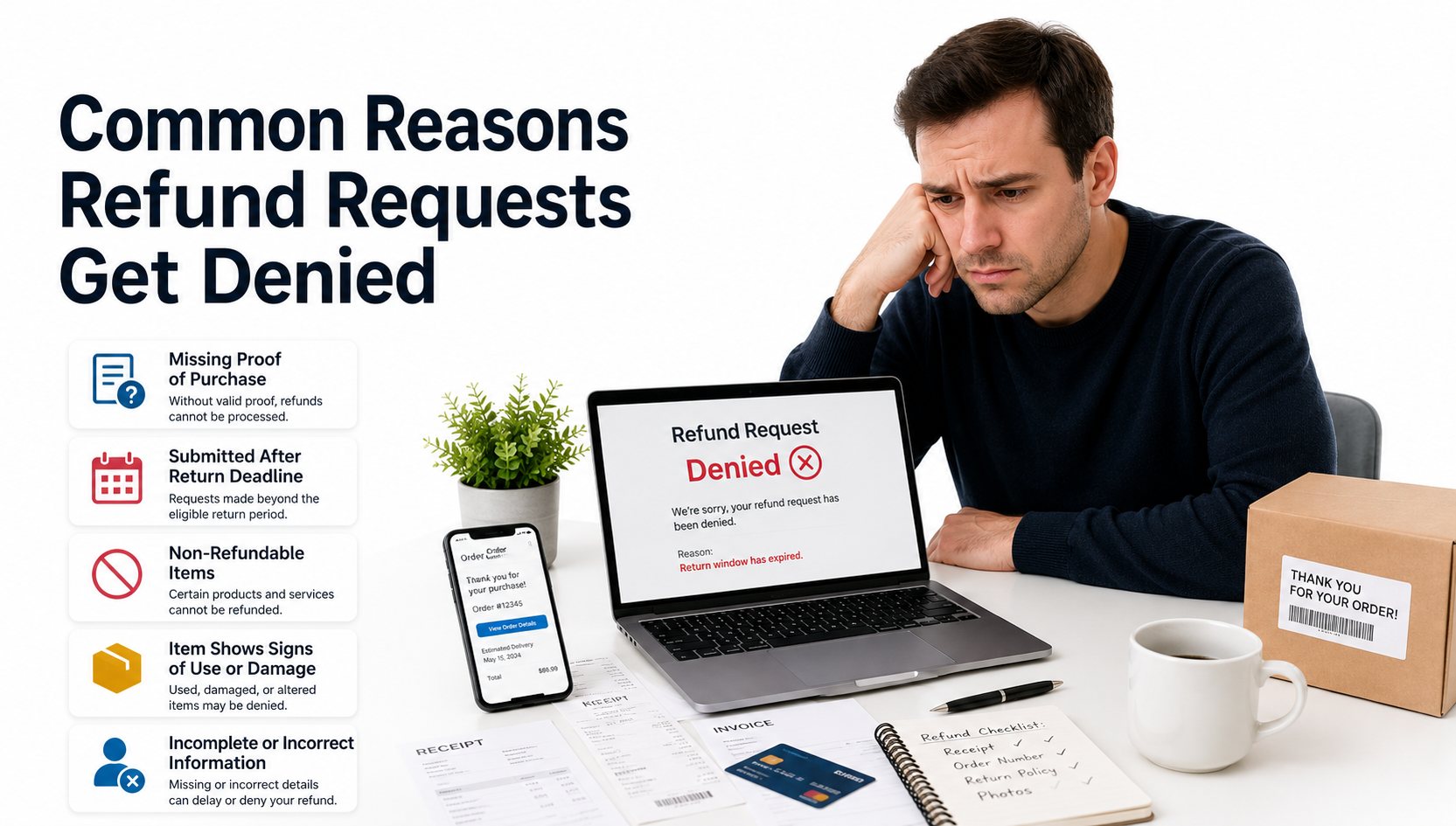

A refund request denied notice usually comes down to a handful of recurring issues: the return window closed before the request was made, the product didn't meet return conditions, there was no proof of purchase, the purchase fell under a non-refundable policy exclusion, or the paperwork submitted was incomplete. Damaged, used, or missing-accessory items are also common triggers. Common Reasons Refund Requests Get Denied
The good news is that many denials aren't final. Providing bank statements, photos, order confirmations, or written correspondence can often turn a rejected refund into an approved one, especially when the request is resubmitted clearly and professionally.
Why Refund Denials Happen
Getting a refund request denied can feel discouraging, especially when a purchase genuinely didn't work out. But a denial isn't always the end of the road, and understanding why businesses reject refund requests can help consumers avoid common mistakes and improve their odds of a fair outcome. In most cases, a denial isn't personal. It's the result of a policy, a missing piece of documentation, or a misunderstanding that can often be cleared up with the right follow-up.
Why Businesses Deny Refund Requests
Companies generally deny refunds for one of a few structural reasons: the request falls outside their stated policy, required documentation wasn't provided, the product's condition doesn't qualify, the payment method or timing created a conflict, or the item falls into a category the business doesn't refund at all. Recognizing which category applies to a specific situation is the first step toward resolving it.
Common Reasons Refund Requests Get Denied
1. The Return Window Has Expired
Most retailers set a specific return deadline, often between 14 and 90 days from the purchase or delivery date. Once that window closes, a refund request denied response is the default outcome, even for otherwise reasonable requests. Exchange periods are sometimes shorter or longer than refund periods, so it helps to check both separately before assuming eligibility.
2. The Product Doesn't Meet Return Conditions
Retailers typically require items to be returned in resellable condition. Requests get rejected when the product has been used, shows customer-caused damage, or arrives without its original accessories or packaging. A phone missing its charging cable or clothing with tags removed can be enough to trigger a denial.
3. No Proof of Purchase
Without a receipt, order confirmation, or transaction record, a business has no reliable way to verify the purchase happened, or that it happened where the customer claims. This is especially common with gift purchases, where the recipient never saw the original receipt.
4. Refund Policy Exclusions
Some categories are excluded from refunds entirely, regardless of condition or timing. Common exclusions include final sale items, digital downloads, personalized or custom-made products, gift cards, and hygiene-related products such as cosmetics or swimwear. These exclusions are usually stated at checkout, though they're easy to miss.
5. Refund Requested for Non-Refundable Services
Service-based purchases carry their own rules. Booking fees, subscription terms, event tickets, and service charges are frequently structured as non-refundable once the service has been rendered or the booking confirmed, even when the underlying product purchase would otherwise qualify.
6. Chargeback Already Filed
When a customer files a chargeback with their card issuer before contacting the merchant, many businesses will pause or deny the refund request on their end. This prevents the customer from being refunded twice for the same transaction while the bank's dispute process runs its course.
7. Incorrect or Incomplete Refund Request
A surprising number of refund rejections come down to paperwork. Missing order numbers, incorrect account details, or a request that doesn't explain the underlying issue can result in an automatic denial, even when the underlying claim is legitimate.
8. Product Shows Signs of Misuse
Businesses often distinguish between a manufacturing defect and damage caused after purchase. A cracked phone screen, for example, reads very differently to a reviewer depending on whether it appears consistent with a drop or with a factory flaw.
9. Fraud Prevention Measures
Retailers increasingly flag refund requests tied to suspicious purchasing patterns, repeated refund claims from the same account, or unverified identity information. These measures are designed to catch return fraud, but they occasionally catch honest customers as well.
10. Processing Errors or Miscommunication
Not every denial reflects an actual policy violation. System errors, delayed status updates, and simple miscommunication between customer service representatives can all produce a refund request denied notice that doesn't hold up once someone reviews the account manually.
How to Improve Your Chances of Getting a Refund
A denied refund isn't always final. These steps can help turn a rejection into an approval.
Step 1: Review the Refund Policy
Before responding to a denial, re-read the specific policy that applied at the time of purchase. Policies are occasionally updated, and the version that governed the original transaction is the one that matters.
Step 2: Gather Supporting Evidence
Strong documentation makes disputes easier to win. Useful evidence includes:
- Original receipts or invoices
- Order confirmation emails
- Screenshots of the product listing or refund policy
- Photos of the item's condition
- Email or chat transcripts with customer service
Step 3: Contact Customer Support Professionally
A clear, factual message that references order numbers and dates tends to get resolved faster than an emotional one. Staying professional keeps the conversation focused on the facts rather than the frustration.
Step 4: Escalate the Request
When frontline support can't help, ask to speak with a supervisor or a customer relations team. A written complaint, sent by email rather than chat, also creates a paper trail that's useful if the dispute continues.
Step 5: Consider Alternative Options
When direct escalation doesn't resolve the issue, consumers can consider a card issuer chargeback, a report to a government consumer protection agency, or a public complaint on a consumer platform to document the dispute for others.
Refund Denial Reasons at a Glance
|
Reason Refund Was Denied |
Possible Solution |
|
Return period expired |
Request store credit or an exception |
|
Missing receipt |
Provide a bank or card statement |
|
Product damaged |
Submit photos and a written explanation |
|
Final sale item |
Review the store policy carefully |
|
Incomplete request |
Provide the missing information |
|
Refund processing delay |
Follow up directly with customer support |
Understanding Your Consumer Rights
Refund rights in the United States depend heavily on the retailer's own policy, since federal law generally doesn't require businesses to offer refunds for a simple change of mind. That said, credit card protections can offer a separate path for disputing a charge, billing errors are covered under specific consumer protection rules, and certain product categories carry their own return requirements. Because refund rights vary by retailer, payment method, product type, and state law, it's worth checking the specific terms that applied to a purchase rather than assuming a blanket rule applies.
Common Refund Mistakes Consumers Should Avoid
1. Waiting too long to submit the request
2. Throwing away receipts or order confirmations
3. Ignoring the retailer's stated return policy before purchasing
4. Sending emotional or confrontational messages to support teams
5. Failing to keep documentation of communications and product condition
How RaiseAComplaint.com Can Help
When a refund dispute stalls despite following the right steps, RaiseAComplaint.com gives consumers a place to share their experience, document an unresolved refund dispute in detail, and raise a complaint that businesses and other shoppers can see. Publishing a clear, factual account of what happened won't guarantee a specific outcome, but it creates a public record that can encourage a business to re-engage constructively, while helping other consumers make more informed purchasing decisions.
The Bottom Line
A refund request denied notice is frustrating, but it's rarely the final word. Expired return windows, missing documentation, product condition, and policy exclusions account for most denials, and each of these can often be addressed with the right evidence and a clear, professional follow-up. Reading the retailer's policy carefully, keeping thorough records, and escalating calmly when needed all improve the odds of a fair resolution. When a dispute still can't be resolved directly with a business, trusted complaint channels like RaiseAComplaint.com offer a constructive way to document the issue and move the conversation forward.
Frequently Asked Questions
Why was my refund request denied?
Refund requests are most often denied because the return window expired, the item didn't meet return conditions, proof of purchase was missing, or the purchase fell under a policy exclusion like final sale or digital goods. Reviewing the denial reason against the store's policy is the best starting point.
Can I challenge a denied refund?
Yes. Many denials can be reconsidered when a customer provides additional documentation, such as receipts, photos, or correspondence, and requests a review through customer support or a supervisor. Escalation and a clear written request often lead to a different outcome.
What evidence should I provide?
Useful evidence includes the original receipt or order confirmation, photos of the product's condition, screenshots of the return policy at the time of purchase, and any email or chat records with customer service documenting the issue.
Can I file a chargeback after a refund is denied?
In many cases, yes, particularly if the denial appears to conflict with the retailer's own stated policy or the card issuer's dispute rules. It's worth reviewing the card issuer's specific chargeback requirements and time limits before filing.
What happens if a company ignores my refund request?
Consumers can escalate to a supervisor, submit a written complaint, contact their card issuer about a possible chargeback, or document the dispute on a consumer complaint platform to encourage a response and inform other shoppers.
Are businesses legally required to offer refunds?
Not generally for a simple change of mind. Refund obligations mostly come from the retailer's own stated policy rather than federal law, though certain situations, such as billing errors or specific product categories, carry additional protections.
How long should I wait before following up?
A reasonable follow-up window is typically five to ten business days after the initial request, unless the company's policy states a different timeline. Following up in writing helps keep a clear record of the request.
Does a store credit count as a refund?
Not exactly. Store credit returns value toward a future purchase with the same retailer, while a refund returns money to the original payment method. Some denials are softened into store credit as a compromise.